The Five-Meeting Paradox: When B2B Founders Start Selling Harder
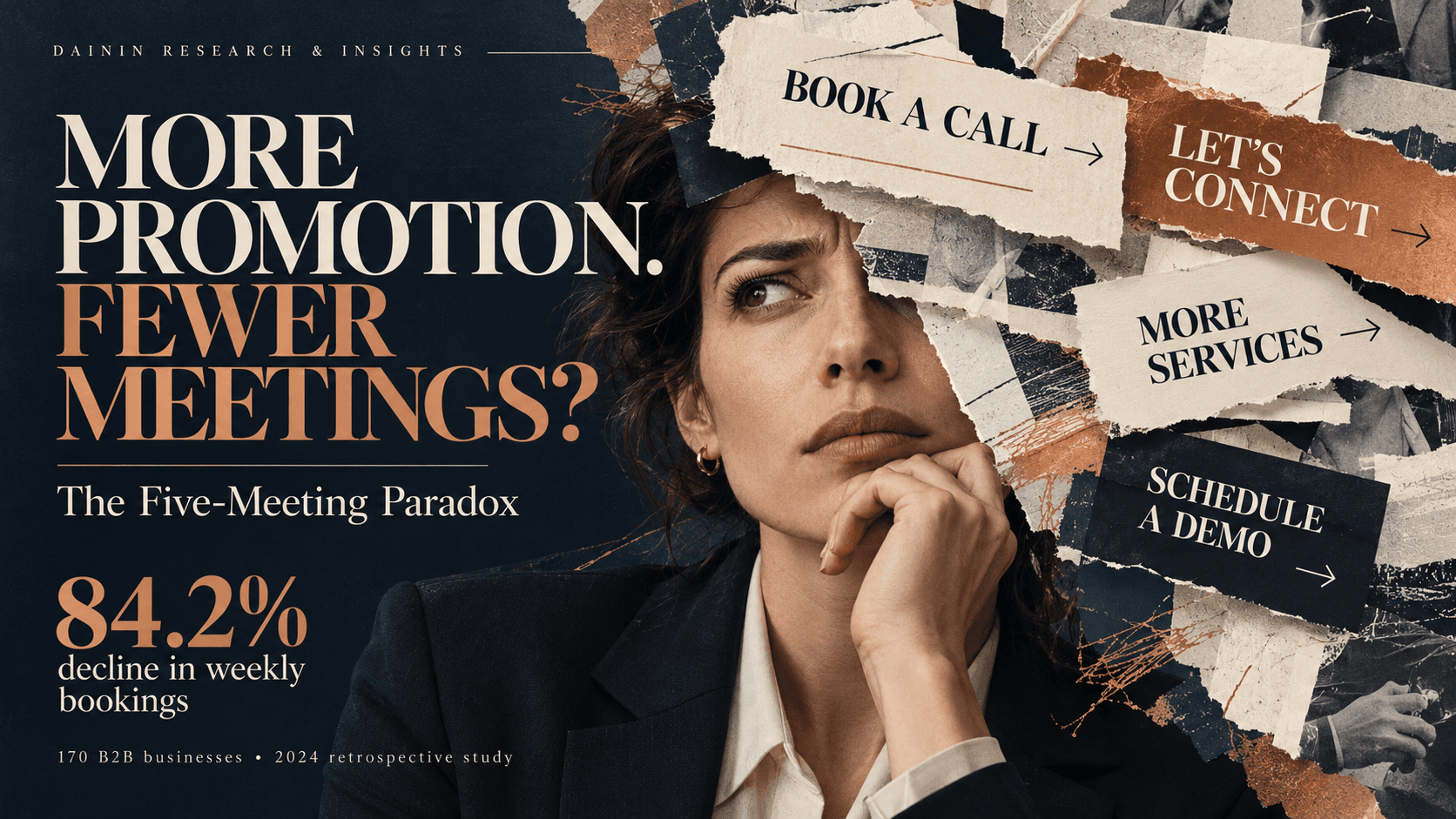
Dainin's analysis of 170 B2B businesses found an 84.2% decline in weekly calendar bookings among firms changing their professional positioning, compared with 3.2% among those maintaining the recommended approach. The underlying targeting, automated outreach and follow-up settings remained unchanged.
On this page
- What happens when an experienced professional stops demonstrating what they have achieved and starts concentrating on everything they want to sell?
- "You attract what you fear"
- Fear can make a capable professional communicate as though their availability matters more than their achievements.
- The difference between authority and a service catalogue
- Services make suppliers comparable. Achievements give buyers a reason to distinguish between them.
- Putting the five-meeting paradox under examination
- The critical question: what actually changed?
- Why some founders blamed the market
- A company can continue prospecting while quietly giving customers fewer reasons to respond.
- The value of a system that doesn't panic
- The strongest use of AI may not be making decisions for a founder, but preventing consequential decisions from becoming invisible.
- What the five-meeting paradox really asks
- Research methodology and provenance
DAININ AI Original industry research · 2024 retrospective study
A business owner finally has a prospecting campaign that works.
Prospective clients are responding. Conversations are being confirmed. The business is generating meetings without having to turn every interaction into a sales pitch.
Then the owner decides to improve the strategy.
More services appear on their LinkedIn profile. Their content becomes more promotional. They broaden their audience, rewrite their messages and start selling harder.
The results begin moving in the opposite direction.
This was a recurring pattern reported by Dainin founder Dr Siddharth Jose during the company's work with more than 200 independently owned B2B businesses in 2024.
The participants included marketing agencies, business coaches, management consultants, change-management specialists, exit advisers and other professional-service firms. Collectively, their campaigns targeted buyers in more than 70 industries across 12 countries.
Dainin's founder reports that campaigns consistently following the company's AI-recommended positioning and prospecting approach regularly secured at least five meeting confirmations per week, with approximately three meetings actually attended.
Some prospects booked directly into calendars. Others agreed to a conversation through messages and requested telephone contact. Both were meaningful expressions of interest, although they were recorded separately from attended meetings.
In affected campaigns where owners subsequently changed their positioning and prospecting approach, Dainin reports that calendar bookings often fell below one per week. Some reached approximately two bookings per month.
The sequence prompted a question that has become central to the company's work on professional authority.
What happens when an experienced professional stops demonstrating what they have achieved and starts concentrating on everything they want to sell?#
"You attract what you fear"#
Dr. Sid Jose has a phrase for the behaviour he believes contributed to the pattern.
"You attract what you fear."
He invokes the expression not as a supernatural principle, but as an observation about how entrepreneurs react under commercial pressure.
A business owner worried about an empty calendar may start promoting every available service, approaching a wider audience and making increasingly direct requests for appointments.
Each decision can appear reasonable in isolation.
Together, they may transform the owner's professional identity.
A profile that previously communicated achievements, experience and judgement begins to resemble a catalogue of services.
The business is still visible. The founder is still active. The company may even be sending as many messages as before.
But prospective customers are encountering a different proposition.
Organisational research provides a useful context for this interpretation. In 1981, Barry Staw, Lance Sandelands and Jane Dutton published their work on threat-rigidity effects, describing how perceived threats can restrict information processing and narrow organisational responses.
The relevance to founder-led selling is not that every struggling business owner acts out of fear. That would require evidence about individual motivations.
It is that commercial pressure can influence decision-making in ways that deserve examination alongside conventional marketing metrics.
Fear can make a capable professional communicate as though their availability matters more than their achievements. #
The difference between authority and a service catalogue#
The distinction matters after an introduction, too. A prospect who receives a message grounded in specialist expertise may then encounter a public profile dominated by generic service claims. The evidence that originally justified the introduction becomes harder to recognise.
Dainin's proprietary Above-the-Offer positioning methodology begins with a professional's record rather than their product catalogue.
What has this person accomplished? What outcomes have they delivered? What decisions have they been responsible for? Which prospective customers would value those achievements?
Consider an exit adviser.
A service-led profile may advertise valuations, succession planning, transaction support and business exit preparation.
Those services may be highly relevant, but they are also available from numerous competitors.
An adviser with a documented history of completing complex transactions or guiding successful ownership transitions has a different foundation for commercial positioning.
Their achievements provide evidence of capability. Their services explain how that capability can be accessed.
The same distinction applies to management consultants with substantial operational results or agencies that can demonstrate measurable improvements in clients' commercial performance.
Dainin's methodology evaluates the highest credible authority position supported by a person's achievements, experience, evidence and relevance to the intended buyer.
The objective is not to exaggerate qualifications or invent status.
It is to prevent demonstrable professional value from disappearing beneath a list of products.
Services make suppliers comparable. Achievements give buyers a reason to distinguish between them.#
Putting the five-meeting paradox under examination#
Dainin's historical experience led to a retrospective comparison of businesses that changed their campaign strategy and businesses that maintained the recommended approach.
Research participant flow
| Population | Businesses |
| B2B business population | 204 |
| Excluded for insufficient or ambiguous records | 34 |
| Eligible for paired comparison | 170 |
| Owner-directed strategy changes | 112 |
| Campaigns maintaining recommendations | 58 |
The design produces 4,420 business-week observations and distinguishes outreach activity, meeting confirmations, calendar bookings and attended meetings.
This is important because a prospect agreeing to a telephone conversation is not necessarily equivalent to a calendar booking, and neither guarantees attendance.
Meeting outcomes
The following values are verified 2024 campaign records.
| Weekly outcome | Changed: before | Changed: after | Maintained: before | Maintained: after |
| Confirmed meetings | 6.72 | 1.21 | 6.74 | 6.53 |
| Calendar bookings | 5.02 | 0.79 | 5.08 | 4.91 |
| Meetings attended | 2.83 | 0.47 | 3.00 | 2.89 |
| Outreach attempts | 96.67 | 91.38 | 95.35 | 94.74 |
In the comparison, weekly calendar bookings decline by 84.2% among businesses classified as having changed their approach, against a 3.2% decline among businesses that maintained it.
The analysis also shows a substantial change in the distribution of individual outcomes: 110 of the 112 changed campaigns recorded lower booking rates, while 89 finished with fewer than one booking per week. Two campaigns did not decline.
A business-level statistical calculation produces a difference in booking-rate changes of approximately 4.06 fewer bookings per business per week in the changed group relative to the maintained group, with a 95% bootstrap interval from 3.62 to 4.49 fewer bookings.
The significance of the analysis lies in its ability to examine individual business results, not simply aggregate averages.
The critical question: what actually changed?#
A deteriorating pipeline does not automatically implicate professional positioning.
An owner may also have reduced prospecting activity, broadened targeting, modified an offer or changed follow-up practices.
External conditions—including seasonality, deliverability, customer demand and industry-specific pressures—may also influence results.
The relevant evidence includes dated professional profiles, changes in the balance between achievements and service promotion, campaign configurations, intended buyer segments and subsequent meeting records.
A particularly useful comparison involves businesses where outreach activity remained broadly similar.
Why some founders blamed the market#
Dainin's founder reports another revealing feature of the experience: how some owners explained their declining meeting activity.
Certain business owners concluded that LinkedIn prospecting was no longer effective.
Others pointed to economic uncertainty, less responsive buyers or the growing volume of generic AI-generated content.
Some departed without giving Dainin an opportunity to review the revised campaigns.
For Dr. Jose, this exposed a second problem beyond the positioning itself.
Business owners could observe a deterioration in commercial outcomes without maintaining an adequate record of the decisions that might help explain it.
The platform, economy or wider market became the apparent culprit.
Yet some of the most consequential changes may have been made within the business.
A company can continue prospecting while quietly giving customers fewer reasons to respond.#
That distinction is particularly relevant for professional services, where buyer confidence depends heavily on the perceived credibility of the person delivering the work.
From professional authority to measurable buyer response
A successful business transaction may make an exit adviser credible to owners considering a similar transition.
Documented operational improvements may establish the standing of a transformation consultant.
A record of measurable client outcomes may distinguish a marketing agency from competitors offering equivalent services.
But achievements do not automatically translate into commercial demand.
They must be relevant to the intended buyer, supported by credible evidence and communicated in a way that makes their significance understandable.
That is why Dainin examines professional positioning alongside audience selection, content and outreach.
The intended result is a consistent explanation of why a particular professional deserves attention from a particular market.
It is also why a change to the professional profile can affect more than the profile itself.
A buyer who receives an introduction based on specialised experience may subsequently encounter a generalised service catalogue. The expertise that originally justified the introduction becomes harder to recognise.
The campaign has not necessarily stopped operating.
The value of a system that doesn't panic#
Commercial pressure can lead a business owner to override a working recommendation without preserving the reasoning behind it.
Dainin has incorporated that evidence discipline into its Cognitive Enterprise Operating System (CEOS).
Its Digital Double retains professional expertise and identity, while the Business Double and Organisation Twin provide commercial and organisational context. Dainin's Above-the-Offer methodology applies that evidence to positioning recommendations, which can inform authorised business workflows.
The Decision Ledger connects consequential decisions with their supporting evidence, subsequent actions and recorded outcomes, allowing reviewed learning to inform future recommendations.
The distinction is continuity. Professional knowledge, recommendations, execution and results are connected through reusable software, rather than reconstructed through separate consulting engagements or isolated AI-generated content.
That does not make the system infallible. The historical study also does not independently establish the predictive accuracy of today's CEOS platform.
The strongest use of AI may not be making decisions for a founder, but preventing consequential decisions from becoming invisible.
The strongest use of AI may not be making decisions for a founder, but preventing consequential decisions from becoming invisible.#
Jose's separate 2025 Doctor of Business Administration dissertation, Analysing Digital Trails for Targeted Digital Marketing, examined the role of digital information, relevance and personalisation in marketing effectiveness.
What the five-meeting paradox really asks#
Dainin's historical observations suggest a tension that deserves closer examination across B2B professional services.
Founders who possess valuable expertise may become less effective at communicating that expertise when they concentrate on selling more aggressively.
Some owners reportedly changed working prospecting strategies, experienced deteriorating meeting activity and attributed the decline to external conditions.
The analysis offers a method for establishing how widespread that sequence was, what happened to comparable meeting rates and whether changes in positioning contributed independently of other factors.
The central question is not whether business owners should stop selling.
It is whether their commercial activity should be built around the services they want to sell or the achievements that make a prospective customer want to engage them.
For founders considering a change to an established campaign, the distinction suggests a useful test:
Has the market given the business new evidence—or has the pressure to win the next customer changed the way the business presents itself?
The answer may determine whether a new strategy represents an improvement or simply a more aggressive version of the same sales pitch.
And that leads to the paradox at the centre of Dainin's investigation.
The harder a professional tries to demonstrate that they need a customer, the easier it may become for the customer to overlook why they need that professional.
Research methodology and provenance#
Publisher: Dainin Research & Insights
Research lead: Dr Siddharth Jose
Research classification: Company-led retrospective observational investigation
Historical period: 2024
Reported commercial programme: 204 independently owned B2B businesses; campaigns targeting 73 buyer industries across 12 countries
Primary outcomes: Explicit meeting confirmations, calendar bookings, attended meetings and prospecting activity.
Comparison method: Analysis using equivalent before-and-after periods, with a separate comparison of businesses maintaining the recommended approach.
Positioning classification: Dated changes to professional profiles, public-facing content, achievement-led positioning and service promotion
Statistical approach: Business-level paired changes, descriptive distributions, bootstrap uncertainty intervals and comparison of changes between the two groups.
Campaign configuration controls: Target-audience settings, automated outreach sequences, follow-up rules and underlying messaging methodology remained unchanged
Study limitations: Retrospective observational comparison; no random assignment; differences in actual outreach activity and unmeasured external conditions may influence outcomes
Related academic research: Dr Siddharth Jose's 2025 DBA dissertation, Analysing Digital Trails for Targeted Digital Marketing, examines digital information, relevance and personalisation in marketing. It is a separate research project and does not share the present study's dataset.
Commercial-interest disclosure: Dainin developed and commercialises the positioning and prospecting systems discussed.
References
- Jose, S. (2025). Analysing Digital Trails for Targeted Digital Marketing. DBA dissertation, Swiss School of Business and Management Geneva.
- Staw, B. M., Sandelands, L. E., & Dutton, J. E. (1981). Threat-Rigidity Effects in Organizational Behavior.
- EQUATOR Network — STROBE observational reporting guidelines.
- LinkedIn — How LinkedIn Is Improving the Feed, March 2026.